 Pedagogue
I teach ninth graders.
Then I teach the people
who teach everyone else.
Lesson frameworks. Keynote talks filmed in real classrooms. A weekly newsletter read by curriculum directors who act on it.
Room 214, Jefferson High.
A writing problem nobody had solved.
In 2021, 68% of ninth graders at Jefferson High in Chicago scored below grade level on argumentative writing. The school had tried three different curricula. None of them worked. This is what I did instead.

Students could produce sentences. They couldn't build arguments. The gap wasn't vocabulary — it was structure they couldn't see because no one had ever made it visible.

I designed the Argument Skeleton Framework — a visual scaffold where students physically map claim, evidence, and warrant before writing a single sentence. Six weeks. No textbook.
I've seen curriculum interventions come and go for twenty years. This is the first one where I watched a student who hated writing ask to stay after class to finish her essay.
A framework isn't a script. It's a lens. The teacher who understands the lens can improvise with it — and that's where the real teaching lives.
Riverside Academy
asked me to stay
for a whole year.
What started as a two-day workshop in Room 214 became a school-wide literacy residency. The principal, Marcus Webb, had seen the writing scores. He wanted to know if the framework could work across every department — not just English. Math teachers. Science teachers. History teachers. All of them learning to teach argument structure through their own disciplines.
Over nine months, I ran 34 professional development sessions, co-taught 12 demonstration lessons, and built a shared vocabulary for academic writing that every teacher in the building now uses. The framework didn't just transfer — it evolved when science teachers got their hands on it.
"She didn't come in and tell us what to do. She came in and thought alongside us until we figured it out ourselves. That's the rarest thing in professional development."


If you've seen enough,
the calendar is open.
School principals, conference organizers, and edtech teams — choose your session type and book directly. No intake form. No waiting.
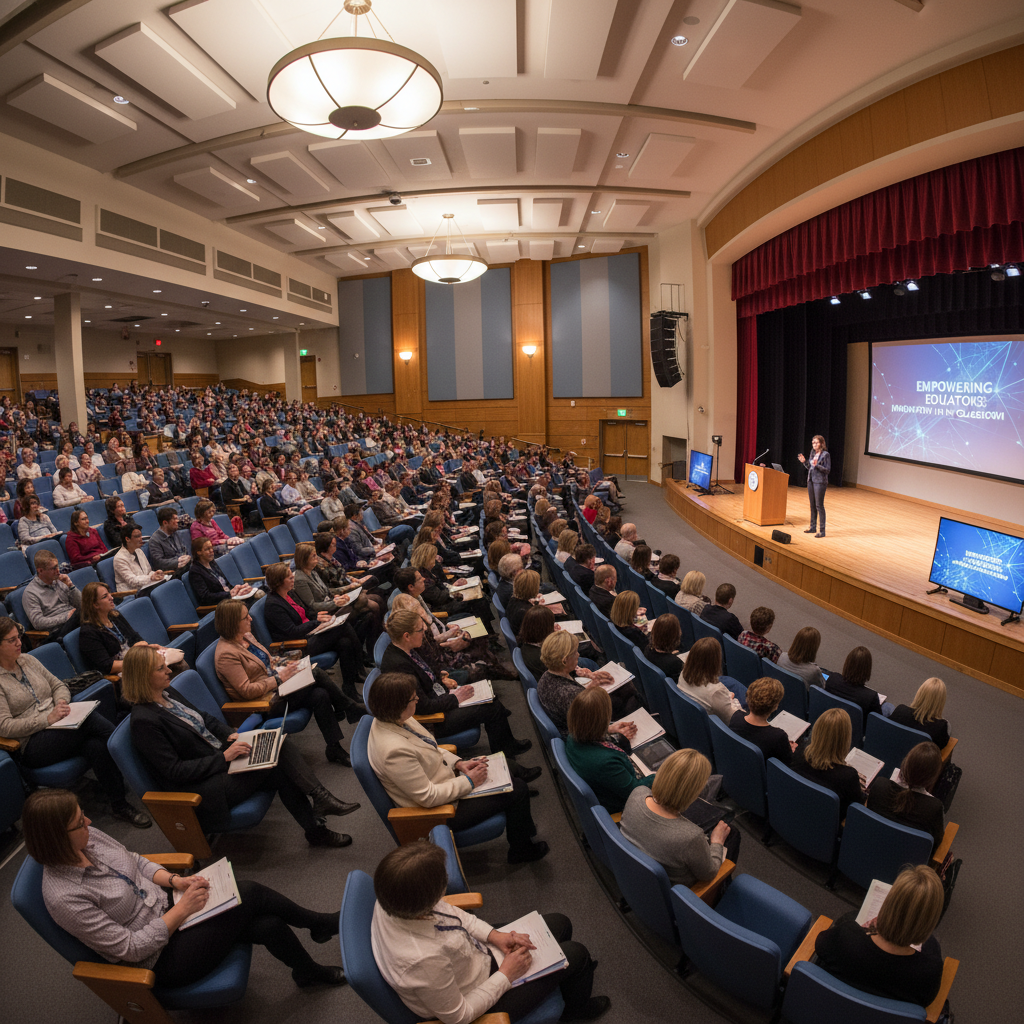
For conferences and all-staff days
Hands-on framework training
Deep-dive school partnerships
The question isn't whether a classroom practice can scale. It's whether the people carrying it understand it deeply enough to let it change when the context demands it.
Chicago Public Schools
wanted to know if one
framework could scale to 14 schools.
In 2023, the district's literacy coordinator found the Argument Skeleton Framework through the newsletter. She called. We spent six months co-designing a district-wide implementation — training 89 teachers, building shared assessment rubrics, and establishing a peer observation protocol that outlasted my involvement.
Where the framework was born. Room 214, Jefferson High.
Riverside Academy. Nine months. Every department.
14 CPS schools. 89 teachers trained. Framework still running.
The hardest part of scaling a classroom practice to a district isn't the training — it's the handoff. I built a train-the-trainer model where eight lead teachers became internal coaches, running monthly calibration sessions after my residency ended. The framework didn't depend on me being in the room.
Three years later, the district literacy coordinator told me that new teachers are still being onboarded to the Argument Skeleton Framework on their first day. It became part of the school culture — not a program, but a language.
"Most consultants leave you with a binder. She left us with a belief system that we actually use. The writing scores are proof. But the real proof is watching a math teacher teach argument structure through quadratic equations."
The frameworks live here.
Take them.
Everything I've built that actually works in real classrooms. PDFs, keynote recordings, lesson plans. No email required for the free ones — just download and use.
The Argument Skeleton
The complete visual scaffold for teaching argumentative writing across any subject. Used in 14 schools.
The First 10 Minutes
How to open any lesson so students are thinking — not just sitting. Six protocols, ready to use.
Teaching as Thinking
45-minute keynote filmed live at a Chicago high school. The talk that started 22 district conversations.
The Feedback Loop
A structured peer-observation protocol that makes teacher feedback specific enough to act on.
Ready to bring this into your school?
Keynotes · Workshops · Multi-Day Residencies